If you want one book that reliably gets preschoolers talking, this is it. The repeated phrases help children join in, the story uses words that imitate sounds, and the setting words build school-readiness language (over, under, through, around).
These are words children need to follow instructions and explain what they’re doing in a Reception classroom — and they come up all day, every day.
It’s also brilliant for confidence because children can “read” parts from memory very quickly.
Price
Expect to pay £3-£5, so it’s a realistic family buy. This book often appears at a low cost in UK retailers, both new and preloved.
Grown-ups’ Guide
Read once for fun.
Read again and pause so your child can say the repeated bits (even just one word).
Do a 1-minute “bear hunt” at home: go through a doorway, under a table, over a cushion — say the words as you move
Words appearing in Word of the Week have been chosen to support the DfE (Department for Education) emphasis on skills and vocabulary required for children from birth to age 5. These skills and goals are set out in the Early Years Foundation Stage Framework (EYFS), which is designed for early childhood learning.
Use this word as much as you can throughout the week
Say it in real-life moments (mealtimes, bath, getting dressed, play). Point to what’s happening, then use the word in a short sentence. Repeat it often and ask your child to repeat it too.
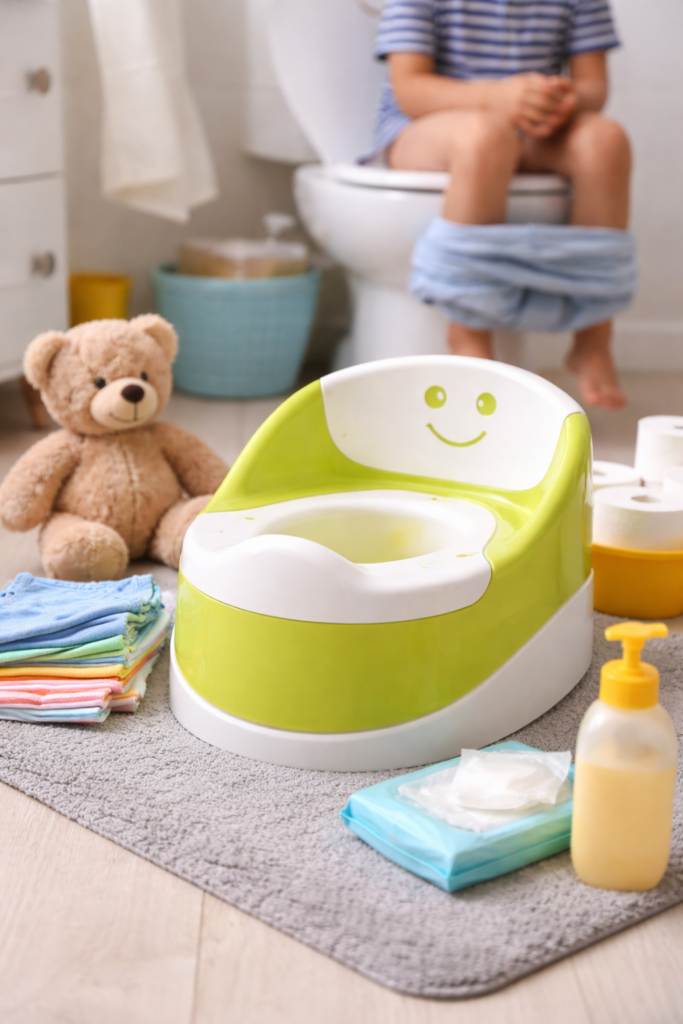
If you’ve got a child starting Reception soon, potty training can feel like the big hurdle. It matters — not because it’s a “test”, but because school routines move fast, and children do best when they’re comfortable and confident.
A February 2024 report by early-years charity Kindred² surveyed over 1,000 teachers about the September 2023 Reception cohort and found that, according to those teachers, around one in four children started school not yet toilet trained, alongside other independence gaps that take up significant school time — teachers reported spending around 2.5 hours a day supporting children who weren’t ready to learn. In other words: you’re not alone, and it’s become a common worry for families and schools alike.
What “Reception-ready” toileting really means
Most schools aren’t expecting perfection. They’re hoping for:
Your child can tell an adult they need to use the toilet
They can pull trousers/leggings up and down (with some help if needed)
They’re happy to sit on the toilet/potty
They can manage wiping practice (often still improving)
They can wash hands with a prompt
When to start: look for readiness signs, not a birthday
The NHS advises that children usually show signs of readiness between 18 months and 3 years, but notes that each child is different and learns at their own pace. Their guidance sets out what to look for: your child noticing when they’re doing a wee or poo, being able to sit on a potty and get back up again, and starting to communicate when they need to go. By age 3, the NHS notes that 9 out of 10 children are dry most days — though even then, accidents are normal, especially when children are excited or absorbed in something else. By age 4, most children are reliably dry during the day.
If it’s feeling like a daily battle, that’s often a sign to slow down, reset, and try again in a few weeks with less intensity — the NHS is clear that you cannot force a child who isn’t ready.
A simple plan that works for busy parents
Pick one routine moment (after breakfast, before bath) and make it predictable.
Dress for success: leggings/joggers, easy underwear, avoid fiddly buttons at first.
Tiny rewards: praise the effort (“You tried!”), not just the result.
Neutral cleanup: accidents are information, not “naughty”.
One clear script: “Your wee/poo goes in the toilet. Let’s try.”
On a personal level, I found that my children were keen to do what their peers were doing – if their cousins or ‘older’ friends were using a toilet, they wanted to do the same. So if you are lucky enough to have children around who are slightly older than your toddler, you could arrange supervised play dates so that your toddler sees the toilet or potty as a natural step in them growing up.
If it’s not clicking
Watch for constipation, fear of the toilet, or repeated distress. The NHS recommends speaking to your GP or health visitor if these are in the mix — they can refer you to a specialist clinic if needed. ERIC, the Children’s Bowel and Bladder Charity, also offers a free helpline (0808 801 0343) for families who need extra support.
Reception readiness isn’t about rushing. It’s about helping your child feel capable — and toileting is one part of that bigger picture: independence, communication, and confidence.